Engagement Sequence Overview
Most community engagement failures don’t happen in the sessions. They happen months earlier — in the sequence of decisions made while designing the engagement.
This is the map. Use it before diving into any feature-level documentation. Each step in the sequence creates the conditions the next step requires, and CE Canvas is built around this order of operations.
This guide is for:
- Engagement practitioners in local government, state agencies, and the private sector
- Project managers who lead or commission engagement work
- Community development professionals at the interface between organisations and communities
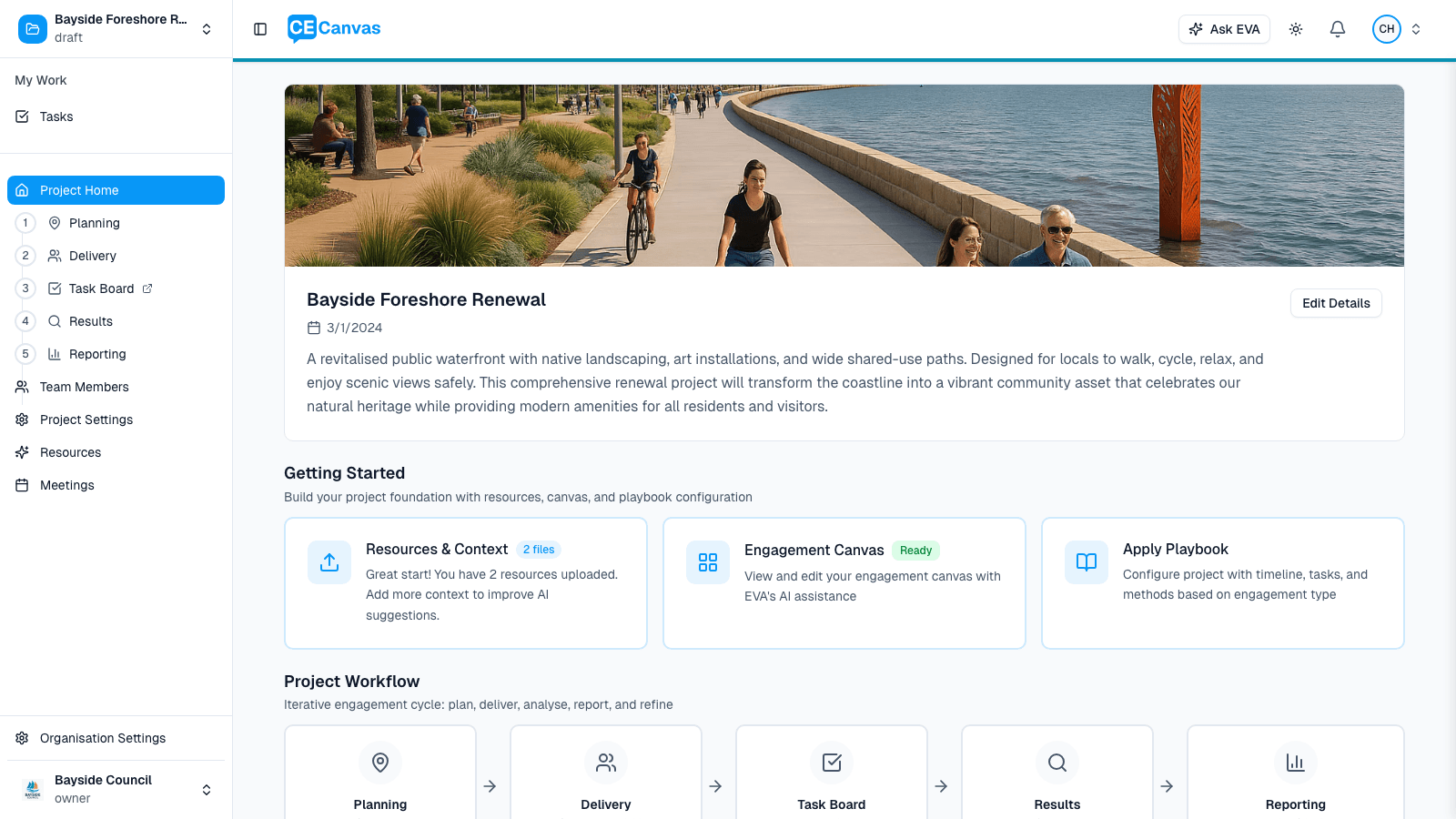
The CE Canvas project journey reflects this sequence directly: the sidebar carries every project through Planning (Context → Canvas → Plan), Delivery, Results, Reporting, and Close & Learn — with Tasks as a persistent item above the journey — and Project Home always points at the single next useful action. The journey is orientation, not a gate: practitioners can move between stops at any time, but the sequence below is the order that makes the work sound.
The 10-step sequence
Decision foundations — Steps 1–4
These four steps must be completed before any stakeholder is contacted or any session designed. Skipping them doesn’t save time — it means the rest of the process is built on unexamined assumptions.
Step 1 — Map the decision space Establish what decisions are actually being made, who holds authority over them, and when the window for community influence opens and closes.
When skipped: Engagement is designed around internal project schedules rather than decision milestones. Communities participate after key decisions have already been made. Input cannot influence outcomes because the window has already closed.
Step 2 — Establish scope and constraints honestly Document what is genuinely open for community influence and what is fixed — by legislation, prior commitment, or technical constraints — before engagement begins.
When skipped: Constraints that were not disclosed upfront emerge during or after the engagement. Communities feel misled. Trust erodes. Future engagement credibility is damaged.
Step 3 — Define engagement objectives Engagement objectives answer: what do we need to understand from the community that we cannot understand without them? Not: what will we do in the sessions?
When skipped: Methods are chosen by habit rather than purpose. Teams reach for familiar tools without asking whether those tools will produce the information the project needs. The result is data-rich but insight-poor engagement.
Step 4 — Choose the level of engagement — and honour it Inform, Consult, Involve, Collaborate, Empower. These are not points on a scale from lesser to better. They are promises about the degree of influence communities will have.
When skipped: Teams choose Involve or Collaborate because it feels more respectful, without the earlier analysis to support it. Communities experience a gap between what the level implied and what the process delivered. That gap is experienced as broken trust.
Engagement design — Steps 5–7
With the decision space, constraints, objectives, and engagement level established, you can design the engagement itself. In that order — not before.
Step 5 — Map your stakeholders Stakeholder mapping identifies who must be heard, surfaces barriers to participation for each group, and creates documented commitments about who the organisation will invest in reaching.
When skipped: Engagement design defaults to who is easiest to reach. Questions are written for general audiences. The communities most affected are systematically underrepresented.
Step 6 — Design questions and content by stakeholder group Different groups need different framing, different depth, and different entry points to the same set of issues. One-size-fits-all engagement produces data that reflects the most accessible participants, not the full range of affected communities.
When skipped: Data reflects the views of the most engaged and most accessible participants. The full range of affected community perspectives is not captured.
Step 7 — Select methods through the lens of barriers For each stakeholder group, tool selection should start with one question: what barriers does this group face in participating? The answer determines method choices — not budget, not familiarity, not what worked on the last project.
When skipped: The same groups are systematically under-reached across multiple projects. Teams attribute this to community disinterest. The actual cause is method selection that was never designed to overcome their specific participation barriers.
Accountability — Steps 8–10
These steps close the loop between what communities said and what decisions were made. Without them, engagement is a one-way extraction of community knowledge with no obligation to demonstrate influence.
Step 8 — Build your evaluation framework before implementation begins Define what success looks like before the first session runs. Process measures: did we reach the right people? Outcome measures: did community input influence the decision?
When skipped: Post-process evaluations measure what is easy to count: sessions held, participants, responses received. Nobody asks whether the engagement improved the decision — because nobody agreed on what improvement would look like before it started.
Step 9 — Track the connection between input and decisions in real time As engagement runs, the thread connecting what communities say to what decisions are made must be maintained actively. This is a governance task, not a documentation task.
When skipped: Teams reach the end of the process knowing broadly what they heard but unable to demonstrate specifically how it shaped decisions. Closing the feedback loop becomes reconstruction rather than reporting.
Step 10 — Close the feedback loop — always, specifically, and on time After decisions are made, go back to the communities who participated: this is what we heard from you, this is how it shaped what we decided, and this is why some of what you raised was not acted on.
When skipped: Community members who invested time and knowledge never learn what happened to their contribution. They participate less in the next process — or not at all. Trust erodes across the whole organisation, not just this project.
How CE Canvas maps to this sequence
The project journey is organised in the same order practitioners need to work. Before any of it: the project classification — can stakeholders influence substantive decisions? — is the first thing CE Canvas asks on a new project, because every later surface depends on an honest answer.
- Planning is a hub of three surfaces in build order: Project Context (the decision foundations, with project materials EVA draws on), the Engagement Canvas (the one-page strategy), and the generated Engagement Plan (when a formal document is needed)
- Delivery, Results, Reporting, and Close & Learn carry the project through execution to accountability, with Tasks always available above the journey
- Closing the Loop is captured as a canvas commitment up front and fulfilled through Reporting
| Sequence step | CE Canvas feature |
|---|---|
| Steps 1–3: Decision space, constraints, objectives | Context — capture the decision space, what is fixed, what is open, key constraints, and engagement foundations; upload project materials so EVA can extract draft content before you begin |
| Step 4: Level of engagement | Engagement Canvas — the Level & Promise section, set once the decision foundations support an honest promise |
| Steps 5–6: Stakeholders, questions, content | Engagement Canvas — the People sections: Stakeholders, Deliberate Outreach, and Key Questions |
| Step 7: Methods | Engagement Playbooks and Delivery — apply a Playbook, then prepare each activity |
| Steps 1–7 structured | Engagement Planning — the Planning hub: Context first, Canvas second, generated Engagement Plan when needed |
| Steps 7–9: Delivery, tracking | Delivery — phases, activities, and EVA-suggested tasks; Tasks — the operational work that executes delivery |
| Step 8: Evaluation | Results — analyse input and check stakeholder coverage against the plan, while there’s still time to act |
| Steps 9–10: Accountability | Outcomes Reports — demonstrate how community input shaped decisions; Close & Learn — activity-level reflection and community feedback obligations |
Sequence is strategy
None of the failures described above require bad intentions, inadequate resources, or poor facilitation to occur. They require only that the sequence is not followed — that steps are reordered, skipped, or run before their prerequisites are in place.
Practitioners who consistently run high-quality engagement have internalised this sequence. They don’t think of it as a framework or a compliance checklist. They think of it as the logic of the work — the order of operations that makes genuine community influence possible.
That thinking is at the heart of CE Canvas. The platform is not a task tracker. It is a sequence discipline tool — designed to make good engagement practice consistent, auditable, and improvable across projects and teams.
Sequence is not a constraint on good engagement practice. It is the precondition for it.
AI support in this sequence
AI can support engagement teams in maintaining sequence discipline — surfacing constraints from uploaded project materials, checking whether the decision foundations are clear enough to support the next step, and tracking the connection between community input and decisions across long processes.
Where AI helps: maintaining sequence discipline, surfacing constraints and likely gaps from uploaded resources, previewing what later stages will require, and supporting traceability between input and decisions.
What stays human: confirming what is genuinely open to influence, deciding what is fixed, determining which communities must be heard, choosing the engagement level the process can honestly deliver, and making final accountability calls.
Governance baseline: require source-linked outputs, maintain human approval at each major step, and keep a complete audit trail of sequence decisions and rationale. AI can guide the sequence, but practitioners remain responsible for confirming the foundations before moving forward.
Continue to the practical guides
- Getting Started — set up your organisation and create your first project
- Context — build the Context Brief and upload project materials to establish Steps 1–3
- Engagement Canvas — capture decision foundations and stakeholder planning
- Engagement Planning — build the written strategy document
- Engagement Playbooks — apply a playbook to structure Steps 5–7
- Delivery — prepare and run each engagement activity
- Tasks — manage and track delivery work
- Results — add engagement data and track outcomes
- Outcomes Reports — compile and share what was heard and decided
- Close & Learn — reflect on methods and fulfil feedback commitments
- Project Team — assign team members to the work
- Responsible Use of AI — how AI features work in CE Canvas and where human judgement applies